March 23, 2014

This Week

There is no such thing as a ho-hum routine week for me in the D.R. In the past week the following has happened:

Dominican Wives Only an Email Away!
  • I went kayaking in the ocean at a friend's site - my life here is sooo tough.
  • I saw a 10 year-old students run naked in front of his house - not the first time I have seen him do this.
  • A Dominican friend asked for my opinion on a job offer she received to become a mail order bride in Europe. I told her that the type of men who need to buy a wife are typically not the kind you want to marry.
  • My power went out, outside of its normal schedule, leaving me in the dark for a few days. I also got to see sparks fly out of the transformer in front of my house, and learn new vocabulary: candela - spark, prestando - flickering, as in the lights are flickering.
  • A teacher painted my fingernails...during class.
  • A boy climbed up a coconut tree and shared the coconuts he knocked down with me, other volunteers, and a security guard who left his rifle lying in the sand while he ate with us.
    Climbing for Coconuts
  • I saw an ostrich while at a teacher training conference at a one room school house. The ostrich is a pet. It is the second pet ostrich I have seen in as many months. You can also buy peacocks from a guy in town.
  • My girls youth group has decided that they want to go to the national book fair in the capital. So far this week they have held a raffle for a gallon of oil, and sold habichuelas con dulce (sweet beans) on the side of the road, just like kids in the States sell lemonade.
  • It didn't happen this week but, while I was traveling the outside of my house was painted!
    Romeo Guarding Our Newly Painted Home

March 10, 2014

Walking

The word andar in Spanish typically means to walk, but here in the D.R. it is mostly used to indicate someone has been traveling. You can imagine my confusion then, when I first arrived, and thought that certain people in my community were avid walkers, but I never saw them exercising. Recently, I have been andando mucho here are the highlights:
Surprise Birthday Party!
For my birthday I went whale-watching with friends; the whales were not too active but it didn't matter because I spent a day on the beach with friends, my community threw me a surprise party, and a bunch of friends sent me cards from America. Thanks for all the love guys!

Following my birthday I spent a few days in the capital discussing volunteer concerns with Peace Corps staff. I arrived back to my site in time for Carnival (the D.R.'s independence day celebrations).
Typical Carnival Costume


The next day I left with three members of my girls youth group to participate in a three-day conference. There were sessions on healthy foods, good relationships, AIDS, as well as, a talent show, and condom party. I was in charge of crafts, so we made friendship bracelets (Thanks, again, Kelly!).
Representing Samaná with Flow (Style)


After the conference I had a break for a few days and then I headed down to Paraíso (Paradise) located the southern part of the country. I didn't travel alone, with me was my friend Courtney, her cat Luna, and her dog Nelly. I had been pet sitting for Courtney for three months while she changed communities (she had security issues at her initial site). The journey took us 15 hours!  We left my home at 3:30 am but only after running around with flashlights looking for Luna after she escaped her pet carrier. The two of us plus Luna squeezed onto a motorcycle with a neighbor who drove us into town where we picked up Nelly and waited for the bus. Once on the bus Luna began to cry just like a baby. Only a cat is worse than a baby because most people, especially Dominicans on a bus at 4:30am, do not have any sympathy - I could feel the loathing of the other passengers. We were charged an extra ticket because of how annoying Luna acted.

We arrived in the capital at 8am and expected to be getting on another bus to the south at 10am. However, the driver of said bus decided not to make the trip that day and we ended up waiting until 2:30pm to continue our journey. Luna, apparently defeated, was quiet for the second leg of the trip. The silence made the views much more enjoyable. We arrived in Paraíso as the sun set, and went to in bed at 8:30pm.

A Tough Place to Live - Paraíso
The next day, Courtney and I walked 10 minutes to the beach that gives the town its name. Later we went to a different beach, San Rafael, where we met up with another volunteer from the region, Sara. I then traveled with Sara to her site, El Palmar. Like me, Sara lives in a campo (farming or countryside) community, but it couldn't be anymore different from my own. Where I have rolling hills covered in palm trees she has flat arid land covered with sugar cane. I live on a highway, Sara lives in a neighborhood with tree-lined sidewalks. My neighbors raise pigs, hers raise sheep. I am bitten up by black flies, while she has so many mosquitoes you can hear them buzzing around in packs (the blood-suckers gave Sara dengue fever - not fun). One thing that was the same between our two communities was the friendliness of the people. Everyone said hello, many gave me hugs and kisses, one man even gave me a beer.
Mountains on the Horizon

The journey back to my site was much less painful without the animals, and it only took nine hours. I was back in my site just long enough to chat with neighbors, hold some meetings, and wash laundry before I set off again. This week I am in the capital working on the volunteer magazine the Gringo Grita (Shouting American). Since I am in the capital, I will have internet and skyping capabilities all week. So, chat me up!

February 17, 2014

A Sister's Eye


Riding in the back of a pick-up truck
Woot, woot! Hey everybody! My name is Kelly and I will be taking over Susan’s blog for this post.  I am Susan’s sister, and as you may be aware, got the chance to spend two weeks with her over winter break.  The whole family travelled around the country the first week, but it was just Susan and I on our own for the second week.  Susan and I had a lot of fun and a few adventures in our week together.  She asked me to write this post to maybe shed light on things that I found interesting that she might have skipped over in her enthusiasm to talk about her project and such.

First off, toilets.  If you follow the Sochi Olympics you might have heard about how they make you throw your toilet paper in the trash instead of flushing it down the toilet.  In the D.R., this is standard.  Even at the swanky resort we stayed at in Punta Cana, signs were posted asking you to not flush the toilet paper.  Simply put, the sewer system in the Dominican Republic cannot handle supporting people flushing their toilet paper.   It’s hard to grasp when you live in a place where automatic flushing toilets are the norm nowadays. 

Note shower head and faucet do not work
Part two of my experience in as it relates to toilets is what is known as “bucket flushing”.  As you may be aware, Susan has no running water.  She does have a toilet however.  How does this work you ask?  Why by bucket flushing of course!  To bucket flush you fill a small bucket, think the size of a small sandcastle bucket, with water that had either been collected the last time it rained, or had already been used in the sink.  I will explain that later.  You stand a foot or so away from the toilet and throw the water with some force into the toilet bowl to basically force most of the old water and such down the pipe.  Bucket flushing is never one hundred percent successful.  You only do it when you do a “number two” so the water is always sort of dirty.  Secondly, it can take a couple of tries to get everything down; sometimes you don’t throw the water hard enough.  Now, about that old water from the sink I mentioned earlier.  Susan has this smart little set up so that any water that goes down the sink drain, whether from washing your hands or brushing your teeth, gets stored in a container which you then use to fill up your little bucket to “flush”.  It’s a great way to recycle and reuse water, a valuable resource in Susan’s community.   It does however leave her bathroom with an odd sort of minty smell though. 

Now enough about bathrooms, let’s look at other interesting things about Susan’s house.  She has no doors except for those leading outside.  Her bedroom, bathroom, and living room areas are all separated by curtains in the doorways.  I guess they allow for better ventilation?  She also has no oven.  In fact, no one in the D.R. really has an oven.  Gas is super expensive and it is hot already there so ovens just don’t make sense.  Instead people cook either on the stove, so there are lots of fried foods, or they will cook outside in plaster type of oven, heated by a charcoal fire.  In an odd way, it made me think of how people must have cooked before stoves and ovens even existed.  The little rooms these fires were in were blistering hot and smoky. 
Plaster based stove with charcoal for fuel
There is no way I could spend more than five minutes in them, let alone all day like most women.  Also washing dishes is a pain when you are trying to conserve water.  Obviously to make sure everything is sanitary, you have to use some of the filtered rain water, of which limited supply exists, so you try and be very careful and maximize the area cleaned per cup of water.  It makes it very apparent just how nice running water truly is. 

Making bracelets by candle light


The people in Susan’s community are awesome.  The kids are of course very friendly and a lot like kids back here in the States.  I taught a bunch of them how to make simple friendship bracelets with some embroidery floss our mom sent in a care package before.  It was incredible to see how some kids picked the skill up in now time at all while others, like Susan, seemed to struggle a bit more.  Overall the week with Susan was great and totally worth giving up all my downtime between semesters.  I even lost weight by eating the Susan diet of eggs, toast, and jam!

February 7, 2014

Literacy in the D.R.

When I received my invitation to serve in the D.R. I initially thought I was going to be teaching English. It took me a second read-through to realize that the literacy Peace Corps wanted me to help improve was Spanish not English. Others are often confused as well, when I say I am helping to improve literacy rates in the D.R. they assume I mean English literacy. It is such a simple assumption to make, of course a country so close to the States and dependent on tourism would consider English literacy a top priority. It shocks us, fortunate enough to have grown up with the U.S. Public School System, that a nation so close and intertwined with our own could have so many difficulties educating its youth.

Basic literacy in the D.R. is a huge problem, currently the D.R.'s literacy rate is 133 out of 205 countries (from the CIA Work Factbook). What does that number represent?

It represents nine year-old kids in the second grade who can't write their names. It represents the two shift school day, which means students have class for three to four hours a day. It represents the lack of textbooks and workbooks in the classroom (forget computers). It represents the poor pay and poor training of teachers. It represents the days of school lost because rain has made the dirt road too muddy.

The number 133 and all it represents, makes me feel like, at times, the work I am doing is a drop in the bucket. But there are moments that warm my heart, that let me know that my work is important to those I reach. Like when my students smile when they read a word on their own, or when a teacher arranges for students to come to both sessions of school.

I always knew that teachers had a tough and under-appreciated job, but I never realized how hard they have to work until I started working alongside them. If you are a teacher you have my utmost respect. Thank-you for all the work that you do.

Now onto random, non-sentimental thoughts:

  • My grant (that I originally submitted in September) has been funded! I now have a whole $5,000 to put to use. Hopefully the news will get my library committee energized enough to begin building repairs.
  • There was a nation wide commercial strike. All businesses were supposed to be closed for two days to protest rising costs and a potential tax increase. Samaná didn't take things too seriously, most corner stores were open the whole time and nothing closed on the second day.
  • School is tiring me out! I want to be in bed by 10pm at the latest.
  • Last time I was in town the power was out aka no internet fun for me. The town of Samaná is supposed to have power 24/7 but like everything in the D.R. it is not a guarantee.
  • Someone from Majorca asked if I was from Spain. I felt great, until that evening when my project partner gave me a book on Spanish grammar.
  • Things I can't find in town: pot holder, can opener, wine opener, large bowls (for mixing and popcorn), and grape jam (I can find orange, pineapple,  guayaba etc).
  • My 10 year-old neighbor said I was her best friend! So exciting because I think of her as my best friend too. We read and play a lot together, including making karaoke videos to Prince Royce songs. |'ll eventually have good enough internet and post a video of the two of us singing into hairbrushes.

January 29, 2014

Most of the world doesn’t understand “9-5”

 I love reading blogs written by other Peace Corps Volunteers. I like to learn how others handle life as a volunteer, and what they learn from their service. I recently came across a really well written blog by a volunteer serving in Kyrgyzstan. Even though much of his experience is completely different from my my own, I found I could relate to a lot of his thoughts. Below is one of his posts:

I recently saw an article floating around my facebook newsfeed disparaging America for refrigerating eggs. People were like, “What the hell, America?! You are so stupid!” And I was like, if we have resorted to criticizing America for refrigerating eggs, that is actually proof of how great America is. “Oh, no civil war? No mass starvation? People aren’t fleeing the country by the millions? Ok, well I guess everything is going pretty—REFRIGERATED EGGS!! OH MY GOD! ALERT THE PRESSES!”

Just imagine: a country so incredible its affluence permits people to spend hours arguing in weblog comment feeds about the proper temperatures for eggs. Few places on this globe allow for such luxury.


                                                  What about turkey eggs?


It’s now after fall break at my village school, and our recently settled schedule has been messed up again. An outbreak of hep A has obliged our director to ban unnecessary movement throughout the school and keep classes in students’ own homerooms. I suspect at least a few of the absentees are cases of great acting rather than a crippling month long illness. “I can’t go to school, mom. I’ve got that thing, I think, that people are talking about, you know, the one where people get to—I mean—have to stay home from school…”

In one particularly bad day of student attendance last spring, I talked my counterpart into taking a little visit together to the “troubled” students’ houses to talk with the parents. While several of them were supportive and said they would do a better job encouraging, what one mother said caught me off-guard. I asked if school was important and she said yes, but that her son was needed to do the farm work so the family could have food.

I know not everyone in America has it altogether easier, and most people work very hard. But if I had to put a number on the average work schedule here, 5am-9pm would be a little more accurate. People work really, really hard, and especially the women since the lack of running water and consistent electricity tends to hit the domestic chores the hardest.

It’s not always the same kind of work we’re used to in the states, assisted by all our time-savers. But people are doing what they need to do in the moment to secure a future. That means when the coal truck comes to town, you stop what you’re doing, go home, negotiate a price, and then spend the next couple hours shoveling it into your shed. Staying warm is kind of a priority in Kyrgyzstan. Yet this disrupts my neat little 9-5 schedule I have all written out for myself, like I thought I was still in the states or something.

We get up, we brush our teeth, we hit the office, take an hour off for lunch, put in a few more hours and then go home to an evening full of whatever we want to do. We press a button and the dishes are magically polished. We flip a switch and are kissed by warm air. Our biggest complaints are re-matching socks from the dryer or that minute rice actually takes five. Now I scrub my clothes with a bar of soap and that’s after hauling the water from a pump down the street. I never realized what a precious gift I was being handed – that precious gift called time.

Time gives us so many opportunities. We can get a second job, help our kids with their homework, volunteer at a food bank, or even surf the web for articles on eggs. Let’s just not forget what grace a 9-5 affords.

January 24, 2014

My Daily Commute

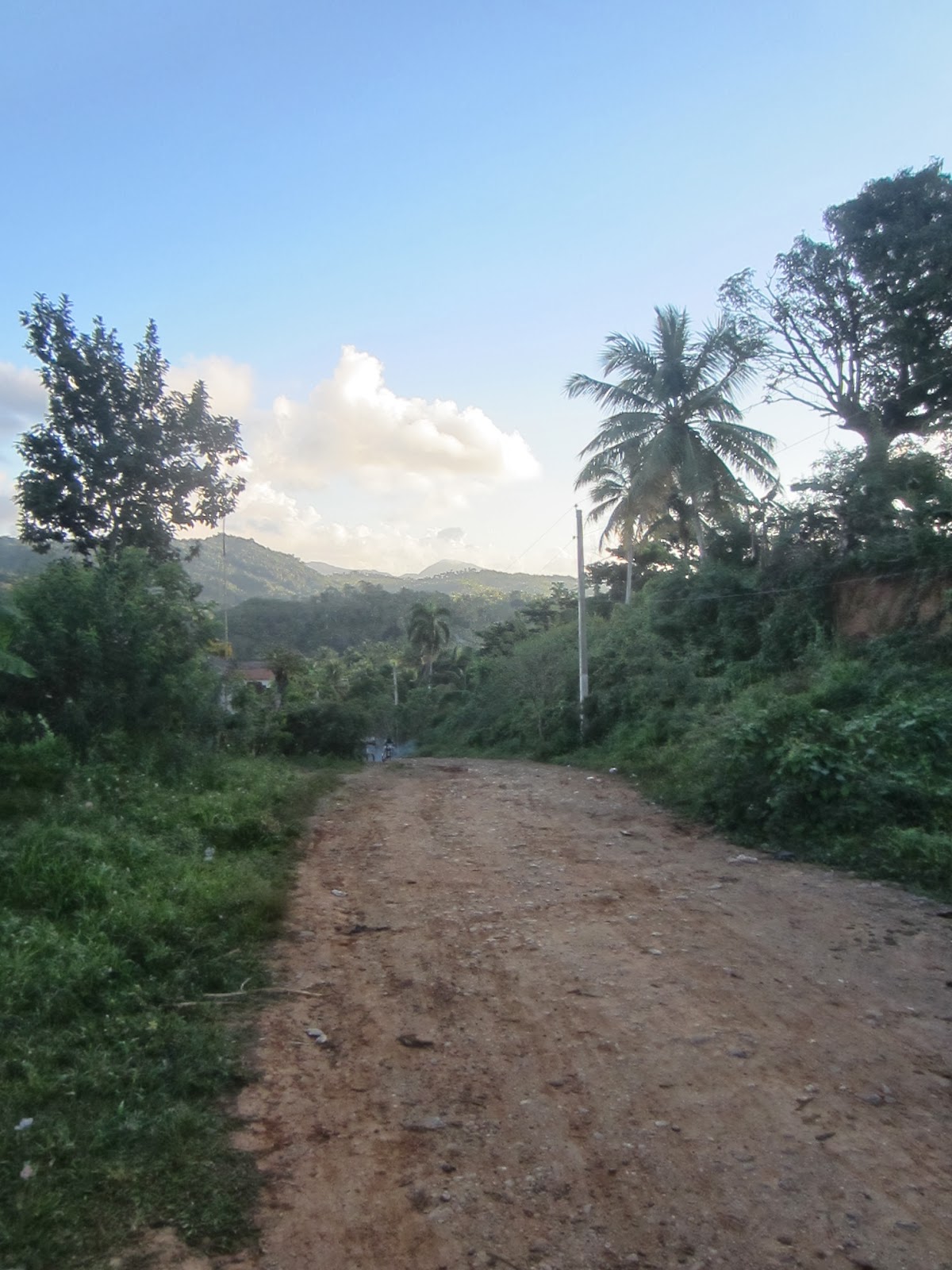
I have always walked to school and now is no different. In total I walk about 5 miles a day to the two schools I work at daily. For the most part I enjoy the walk, I get to say hello to neighbors and exercise at the same time. If I could change one thing, however, I would lessen the incline of some of the hills I am climbing daily. I start off in the morning with this hill on the left. Note that the sun isn't quite up yet, so I can get to the top without breaking a sweat.


Once I am there I get to see a beautiful view as a walk down hill (see below). The walk is not so beautiful on the way back up, under the heat of noon. I will be sweaty and slightly winded by the time I make it to the top.

I take a lunch break at home and then I am on my way again in the opposite direction to the other school. I have to climb another hill, but again I am greeted by a gorgeous view.

A view of the Samaná Bay

So far, all the walking hasn't caused me to be sore, granted we still have yet to have a full week of school. However, I painfully discovered that squatting next to first graders tiny little chairs and table for an entire morning will lead to sore legs. Next week I am going to be pulling up a chair next to my students more often.
Some of the 1st graders

In other news:
  • The grocery store had bacon this week! It was turkey bacon but still delicious.
  • I had my first PCV visitor. It was so nice to have the company of another volunteer, and she taught me some great recipes.
  • I now have a guest bed - just one more reason why you'll should come and visit.

January 10, 2014

Family Withdrawal

"Susan, if you start comparing the Peace Corps to prison, you are going to have a long two years." That's how my friend Sara confirmed my fear that my thoughts were not humorous but depressing. I was going through family withdrawal.

My family visited my in the DR for the holidays, and we had a fantastic time. My dad loved my doña's cooking, my mom overcame her fears and went snorkeling, my brother learned to dance (a little), and my sister became miss popular with the kids in my community after she showed them how to make friendship bracelets. My parents and my brother could only stay a week, and when they left we all cried. My sister stayed a week longer, which helped to ease my family withdrawal but on the eve of her departure I lost my appetite.

The next few days I continued not to eat much, and I spent a large portion of my time sleeping. I knew I was missing my family so I decided to read a book to get my mind off of them. I chose to read Orange is the New Black by Piper Kerman, which is a memoir about one women's year in prison. I thought it would be the perfect book to read, and I was very wrong. Almost immediately I began to make parallels between prison and Peace Corps.* By the time I finished the book I had thought of over a dozen commonalities. Here are the highlights:

 1. Separation from family and friends This is what started my trip down the rabbit hole. Kerman's description of her need to communicate with her family to keep her sane was relatable. In prison there are visiting hours, monitored phone calls, and letters. In Peace Corps there are weekly phone calls and emails, sporadic skype dates, and maybe once or twice a year a visit with family.

I also related to her sense of guilt because she was the cause of the separation. Many volunteers battle with doubt - Was it the right choice to join Peace Corps?, Is it worth it?, Is it fair to our loved ones back home?  Ultimately the majority of us push away the doubt and keep on working, in part thanks to the support our families and friends give us. Thanks for the reassurance!

2. Holidays are a big deal Holidays just are not the same without the family so in both prison and Peace Corps an effort is made to make these annual events fun and keep our minds off our loved ones.

3. Feeling disconnected from the outside world In her memoir Kerman writes about her desire to get a transistor radio so she can keep up with the latest music she keeps reading about in magazines. I too have thought about getting a radio for the same purpose. Most of my current pop music knowledge comes from listening to the music reviews on Fresh Air with Terri Gross. What a sad statement.

4. Care packages In both prison and Peace Corps care packages can make a person's day. They are a sign that someone out in the real world hasn't forgotten us. In both places one is also expected to share the love with others and pass any candy found inside.

5. Making unexpected friends In prison you don't get to choose your cellmates and likewise in Peace Corps you typically don't know any other volunteers until the night before you arrive in country. My Peace Corps friends and I often joke that the chances of us being friends in America would have been slim-to-none. This is in my opinion, one of the best things about Peace Corps. It is great to make connections with host country nationals but it is just as important to form bonds with other Americans.

The friends I have made in Peace Corps have made life in the DR easier. They have been there for the good and the bad, and are always ready to give me a reality check when I start comparing service to incarceration. If you meet a Peace Corps volunteer you should become friends with them - they make great friends - although we do tend to be a little crazy, but then again, you have to be a little crazy to join the Peace Corps.

***

Once Sara helped bring me back to reality my withdrawal symptoms began to recede. By the first day of school I was ready to get back into the swing of things. The students, however, had a different idea. In the morning there were 10 (out of 80+) students at school. In the afternoon not a single kid showed up. Apparently they had not had their fill of Christmas Break. I was told not to bother coming back to school until next week, when apparently school will truly start. I'll keep you posted on how the first real week of school goes.


*Of course there are many, many differences between prison and the Peace Corps places such as the obvious difference that people willing choose to join Peace Corps vs being taken to prison by the police. Also my experience in Peace Corps are completley different from those of other volunteers, even those within the DR.